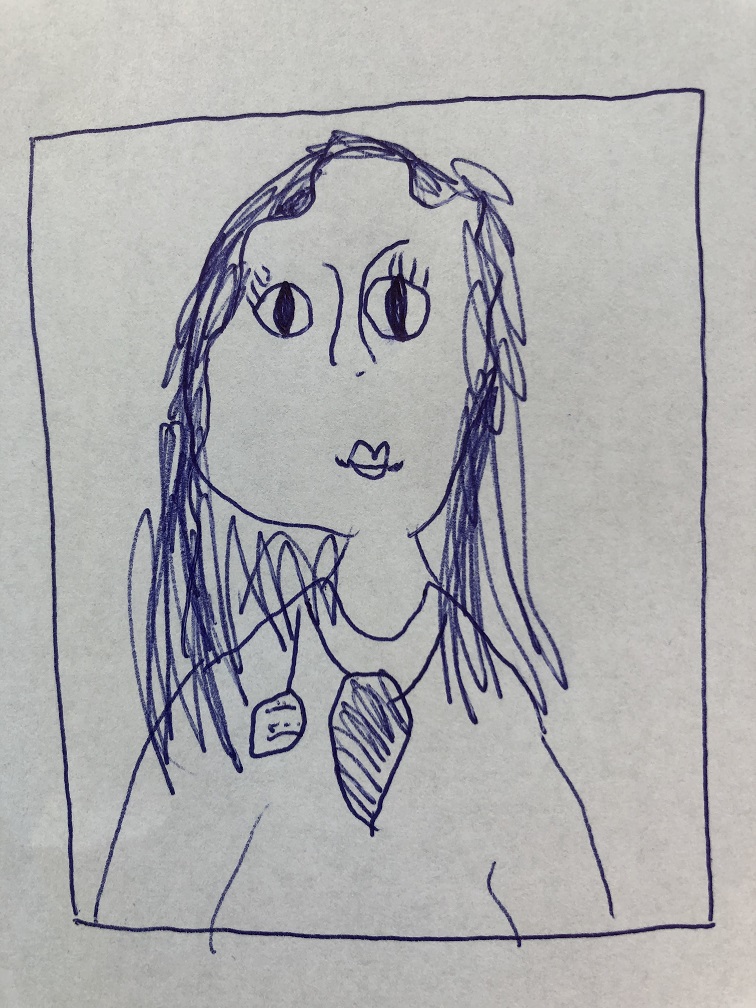
Sofie works at a competence center. She has a natural science educational background. She has worked as a sustainability professional for more than ten years and is approaching forty.
“I want to work with something progressive. To push. To make the world better. Not just the numbers”
Sofie’s sustainability journey started as a wish to combine the subjects she loved: biology and chemistry. Environmental sciences provided her with the answer. Throughout the years, it has become clear to Sofie that she has a goal in her career: to find out how she can contribute more. She therefore immediately showed great interest in talking to me when I told her about my project.
Most of Sofie’s work life has been within the same industry. First as a PhD student and then in a company. But some months ago, she went in a new direction. Now her work is about coordination and getting people into dialogue. She provides platforms where sustainability professionals from different industries, research, and governmental agencies can share experience and build knowledge. “I wanted to jump out of industry and work with sustainability in a broader scope,” Sofie says. I ask her whether she could not have gotten that broader scope working as a consultant or in research as well. She does not think so. ”In consultancy I would only have worked with companies. And in research institutes, the form of work is restricted to, well, research. Here I have the real overview of everyone.”
When it comes to impact, Sofie feels it is still too early to evaluate whether her current workplace has more potential than her previous. She is still finding out how to apply her competence. Before, she worked more hands on, with numbers. “I want to work with something progressive,” she says. “To push. To make the world better. Not just the numbers.” In her current job she sees that the created dialogue between governmental institutions, industry, and research helps to push upcoming legislation in the right direction. She sees a lot of impact potential in fostering collaboration and integrating the life cycle perspective into legislation. But the transition from a technical role into management is not only advantageous. “I miss a bit working in projects and not just management,” Sofie says.
Sofie is not reluctant to return to industry one day in the future. But she has clear criteria for a potential workplace: “Environmental issues must have a top-down approach in the organization, and the employees must know that it is important and prioritized. The sustainability professionals must be listened to.” When Sofie started her career, sustainability was not a “hot concept” but rather a “tick box exercise”. Through the years she experienced how it became an integrated part of the company culture and focus. “I would get very frustrated if I would start working in a company that still was on the “tick box” level.” Since her work life goal has become so much more oriented towards contribution, Sofie also wants to work in an industry where she can identify her contribution easier than in her previous workplace. “I would like to work in an industry with shorter supply chains. Or closer to consumers, with consumables. I want to do something good and see the impact.”
Sofie’s aspiration is thus not to work somewhere with “the highest impact potential possible,” but to work somewhere “where impact can be identified.” When I ask her in which workplace or role she believes the highest impact potential is to be found she answers that it is often to be found in roles associated with policy formulation. “The moment a concept is integrated into legal or regulatory frameworks, the industrial sector tends to acknowledge its elevated importance.” And what about roles or workplaces where sustainability professionals have low impact potential? “It has more to do with how the work is applied. If sustainability efforts are relegated to a mere tick box task, such as just producing a report, or solely publishing a paper, their inherent purpose remains unfulfilled.”
Sometimes Sofie can get envious of professions where contribution is easier to identify. “It is difficult to identify whether you are contributing to slowing down global warming. If you work as a doctor, you cure people and see results immediately. As a teacher you follow the progress of your pupils. In sustainability, you need a longer perspective. There is a common goal for the whole planet, and it is very important that everyone works together. In my work I often wonder: is what we are doing the right method or project to accomplish what is needed?”

 Meaningful sustainability jobs